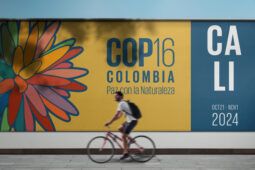

COP16: Hope & Hurdles (start time: 1:20) On this week’s show, host Susan Moran interviews two conservation biologists at Colorado State University — Chris Funk and Liba Pejchar. They both recently attended the United Nations Biodiversity Conference, or COP16, which is still underway in Cali, Colombia, and they share their experiences, perspectives, and optimism from the global gathering. Nearly 200 nations are attending the summit to negotiate targets aimed at slowing the alarming decline in plant and animal species and critical habitats around the world. The outcomes of the talks could determine the roadmap for the future of the planet (despite the fact that the United States has not been a signatory to the global biodiversity treaty). The stakes are high: Biodiversity is shrinking globally faster than at any time in history, with around 1 million plant and animal species currently threatened with extinction, according to an intergovernmental panel of scientists. Two years ago, the biodiversity conference, which convenes every two years, met in Montreal and hashed out a landmark agreement. Among the 23 measures in the accord is a commitment to place 30 percent of the planet, and 30 percent of degraded ecosystems, under protection by 2030. Some progress has been made, yet so far no nations have met their targets, and COP has no enforcement mechanism.
Hosts: Susan Moran, Joel Parker
Show Producer: Susan Moran
Engineer: Joel Parker
Executive Producer: Shelley Schlender
Listen to the show here:
Podcast: Play in new window | Download (Duration: 27:25 — 37.7MB)
Subscribe: RSS


The Blue Plate in a Red-hot World (start time: 7:46) While adding cream to your morning cup of coffee, or digesting the hamburger that you grilled last night, you might not have been asking yourself, What’s the carbon footprint of these ingredients and meals? Understandable. Our guest today, ecologist 

In this week’s show Beth spoke with Marc Bekoff, well known and loved for his decades of research into animal behavior, emotion and cognition, about the new edition of his classic book, The Emotional Lives of Animals. Marc Bekoff is professor emeritus of Ecology and Evolutionary Biology at the University of Colorado, Boulder. For decades he has studied animal behavior, cognitive ethology (the study of animal minds), behavioral ecology, and written extensively on human-animal interactions and animal protection. He centers his work and writing around compassionate conservation, namely the principle of, “First do no harm” and the life of every individual matters because they are alive and have intrinsic value, not because of what they can do for us. We talked about the new edition of his classic book, 
When people talk about going to the Moon, it is often in terms of establishing a station there, or finding water, or doing science