
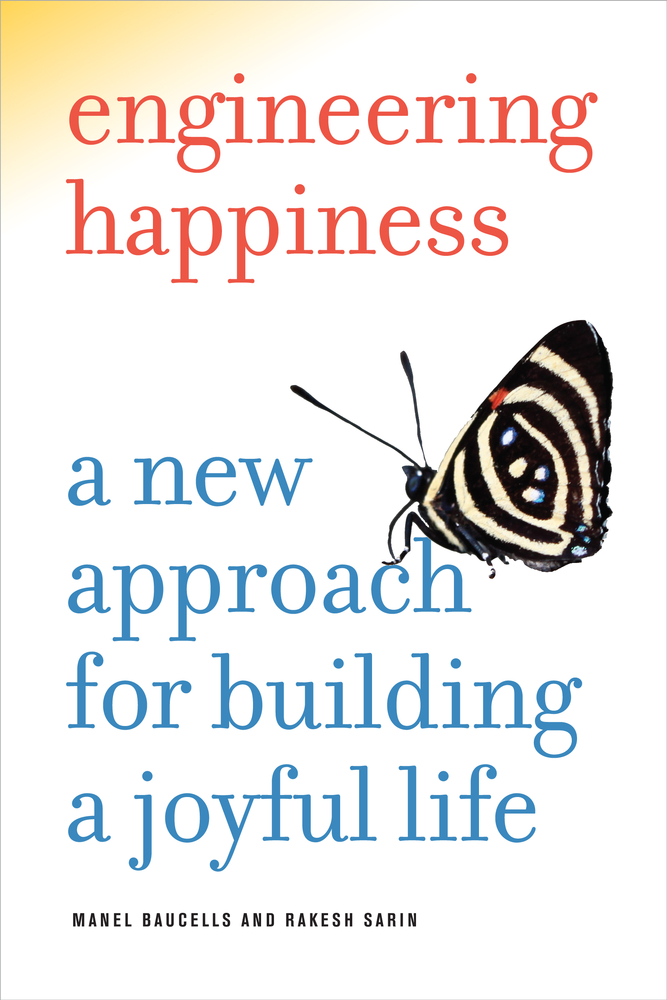
 Engineering Happiness (start time 05:09): You may think the key to happiness lies in money, or love, or more vacation days. But what it really comes down to is math — a mathematical formula, actually. At least that’s according to a recently published book, called “Engineering Happiness: A New Approach for Building a Joyful Life.” It’s co-authored by two business and economics professors: Manel Baucells and Rakesh Sarin. How On Earth co-host Susan Moran interviews Dr. Sarin, a professor at UCLA.

The Effects of Black Holes (start time 14:33): Active Galactic Nuclei, or AGNs for short, are vast black holes at the centers of galaxies. But as big as the AGNs are, galaxies are much, much bigger. Regardless, the AGNs do seem to hold some sway. CU-Boulder astronomer Jason Glenn is part of an international team that is beginning to sort out why, and talks with How On Earth’s Jim Pullen.
Hosts: Beth Bartel and Susan Moran
Producer: Beth Bartel
Engineer: Jim Pullen
Additional contributions: Jim Pullen
Executive Producer: Joel Parker
Listen to the show:

Podcast: Play in new window | Download (Duration: 24:31 — 22.5MB)
Subscribe: RSS



















 Dolphins are intelligent and communicative creatures within their own species and with the other animals native to their waters. Still, a hundred million years of evolutionary history and pressures imposed by radically different environments separate dolphins and humans. Can that enormous chasm be crossed? Can we have a conversation with an alien, a different and intelligent species? Twenty-seven years ago, Dr. Denise Herzing first slipped into the warm and clear Bahaman waters in a quest to answer those questions. And every spring since then, she has gathered the crew, the equipment, the money, the courage and the patience to return to work cooperatively with them, unfettered in the wild. Dr. Herzing believes that first we have to understand dolphin society and give them the freedom to choose to communicate with us. This week on How On Earth, Jim Pullen talks with Dr. Herzing about how she communicates with Atlantic Spotted dolphins (start at 6:48).