How Megafires are Transforming Conifer Forests

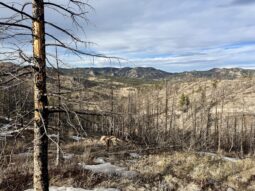
Red Feather Lakes landscape 6 years after Cameron Peaks fire. Photo credit: Susan Moran

Forests Vanishing in Wake of Megafires (start time: 7:55) Increasingly  large and hot wildfires are turning many conifer-dominated forests in the western U.S.and Canada into shrublands or grasslands, largely by making it impossible for ponderosa and other pines to reseed themselves. The stakes are high, for flora and wildlife, as well as humans. For instance, charred conifer forests are causing winter snowpack to melt earlier, changing the timing of water availability and threatening future water supply for the 40-plus million people who live in the Colorado River Basin states and on tribal lands. In this week’s How On Earth, host Susan Moran interviews  Dr. Jonathan Coop, a fire ecologist at Western Colorado University. He’s been monitoring shifts in dry-conifer forests in the western U.S. and Canada for many years. Dr. Coop is the lead author of a study, published recently in the journal Science Advances, about how pine seeds aren’t able to regenerate after super intense wildfires. He also co-authored another recent study, in PNAS, which projects a major further erosion of remaining conifer forests in northern New Mexico if current wildfire patterns persist. Dr. Coop was featured in a recent New York Times article on wildfire trends and impacts.
Action Resource: Fix Our Forests Act

Hosts: Susan Moran, Joel Parker
Show Producer: Susan Moran
Engineer: Joel Parker
Headline Contributors: Beth Bennett, Joel Parker
Executive Producer: Beth Bennett

Listen to the show here:

Play

Clean Water Struggles // 2011’s Big Sci-Enviro-Tech Stories

Mining retention pond in Colorado. Image courtesy of the EPA.

Clean Water Struggles. Co-host Susan Moran interviews journalist Judith Lewis Mernit about how small rural communities in the West are struggling to afford complying with federal water-quality standards as they relate to water pollutants. Mernit wrote an article on the topic in High Country News’ Dec. 12 issue. She explores the unintended consequences of complex federal  standards, which place a disproportionately heavy burden on small communities.  A big bone of contention, and a source of a flood of lawsuits, is a provision in the Clean Water Act that forces states to assess their impaired waterways and set maximum limits, or loads, for nitrates and other pollutants in them.

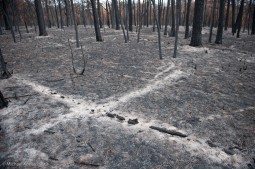
Bastrop, Texas fire. Photo courtesy of Michael Kodas.

2011’s Big Sci-Enviro-Tech Stories. In the second feature co-hosts Susan Moran and Tom Yulsman are joined by How On Earth’s Tom McKinnon and Shelley Schlender, as well as photojournalist Michael Kodas (author of a forthcoming book on megafires) to reflect on 2011’s major science, technology and environment stories. The list includes extreme weather events, record-high carbon dioxide levels, the Fukushima nuclear disaster, Boulder’s November vote to consider municipalizing its electricity, and advancements in proteomics. Stay tuned for plenty more coverage of these topics on How On Earth in 2012. (Scroll down to download the audio file of the show.)

Hosts: Susan Moran, Tom Yulsman
Producer: Susan Moran
Engineers: Tom McKinnon, Shelley Schlender
Executive Producer: Tom McKinnon

Listen to the show:

Play