Hosts: Jim Pullen and Beth Bartel
Producer: Jim Pullen
Engineer: Jim Pullen
Executive Producer: Joel Parker
Listen to the show:

Podcast: Play in new window | Download (Duration: 23:52 — 21.9MB)
Subscribe: RSS
The KGNU Science Show

Hosts: Jim Pullen and Beth Bartel
Producer: Jim Pullen
Engineer: Jim Pullen
Executive Producer: Joel Parker
Listen to the show:
Podcast: Play in new window | Download (Duration: 23:52 — 21.9MB)
Subscribe: RSS

In today’s How On Earth we have two features:
Distributed Energy (start time 5:46): Enjoying the twinkling stars without nighttime light pollution is a luxury for many of us. We can flick on the switch when we return home, after all. But think what would it be like if you were among the 1.5 billion people around the world who lack to centralized electricity. Having no lights at night keeps many of them poor and illiterate, and it can create a public health and national security crisis. How On Earth co-host Susan Moran interviews two experts in the field of distributed and decentralized energy. Rachel Kleinfeld is co-author (along with Drew Sloan) of a new book called “Let There Be Light: Electrifying the Developing World with Markets and Distributed Energy.” She is CEO of the Truman National Security Project. Stephen Katsaros is founder of Nokero, a Denver-based startup company that makes solar LED light bulbs.
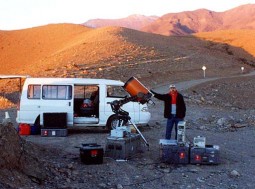
Pluto’s Occultation (start time 16:31): It is a good time these days for watching solar system. Last week there was a solar eclipse, next week is a lunar eclipse and a transit of Venus (where Venus can be seen moving across the disk of the Sun). Next week there is yet another solar system event of one object moving in front of another, though it’s not visible without the aid of a telescope. On June 4th Pluto will pass in front of a relatively bright star, an “occultation” event that will send teams of astronomers scrambling around the world to observe. One team member is How on Earth’s own Joel Parker, an astrophysicist with the Boulder office of the Southwest Research Institute. He’ll be deployed to an observatory in New Zealand to observe the occultation. Joel talks with How On Earth co-host Tom McKinnon on the eve of his adventure about the occultation and why scientists are interested in observing it. (Here’s an article and video about last year’s occulting Pluto.
Hosts: Tom McKinnon, Susan Moran
Engineer: Jim Pullen
Producer: Susan Moran
Executive Producer: Joel Parker
Listen to the show:
Podcast: Play in new window | Download (Duration: 24:45 — 22.7MB)
Subscribe: RSS
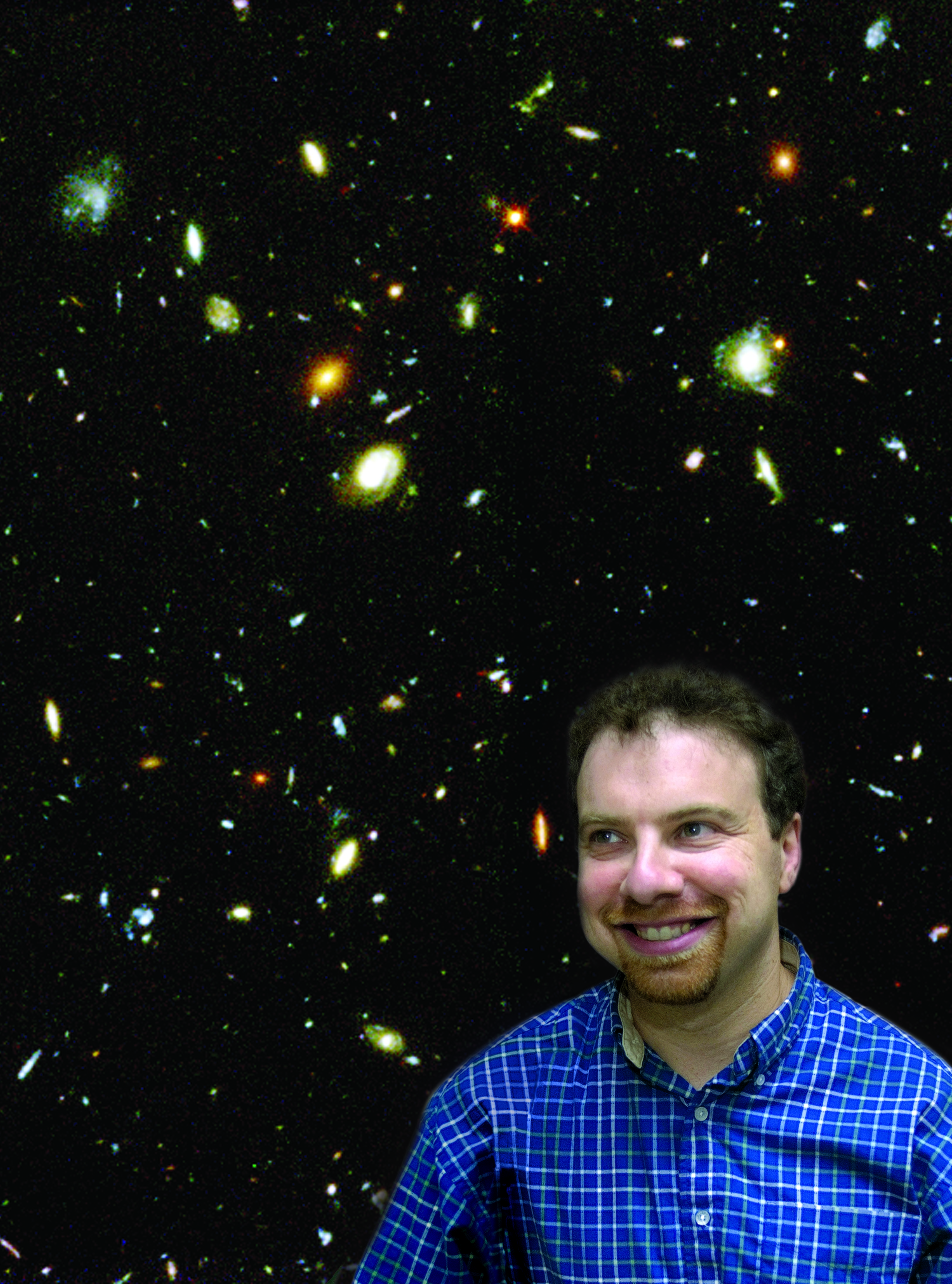
 The Accelerating Expansion of The Universe (start at 5:11). Have you ever had the feeling that things are moving faster and faster these days? Well, maybe it’s not your imagination. Proof that the universe is not just expanding but is accelerating garnered a Nobel Prize last year. To help explain what’s going on, we talk to Dr. Adam Riess, a professor of physics and astronomy at the Johns Hopkins University and is a scientist at the Space Telescope Science Institute in Baltimore. When he was a research fellow at the University of California, Berkeley, from 1996 to 1999, Dr. Riess and his colleagues conducted the research that was to win him a share of the 2011 Nobel Prize in physics. The citation for the prize stated it was: “for the discovery of the accelerating expansion of the Universe through observations of distant supernovae.” In today’s show, Dr. Riess translates what that means and the implications about the ultimate fate of the universe.

Pine Bark Beetles (start at 19:22). The tree-killing pine bark beetles used to breed once a year. Warming annual temperatures now allow them to breed twice, resulting in 60 times more offspring. Hungry, tree-eating offspring. University of Colorado biologists Jeff Mitton and Scott Ferrenberg have just published their findings that the doubled-up breeding season explains why the recent pinebark beetle epidemic has killed so many trees. And it’s not over yet. How on Earth’s Shelley Schlender talks with the scientists about which trees are the most vulnerable to pinebark beetles. You also can hear the extended version of that interview.
Hosts: Joel Parker, Beth Bartel
Producer: Joel Parker
Engineer: Jim Pullen
Headline Contributor: Susan Moran
Executive Producer: Shelley Schlender
Listen to the show:
Podcast: Play in new window | Download (Duration: 24:11 — 22.1MB)
Subscribe: RSS

We celebrate 20 years of How on Earth, featuring the 1st ever KGNU science show, 20 years ago, including Bucky Balls, Electromagnetic Radiation and Cows, Hubble, Bubble, Toil and Trouble, and along the way, we give updates on current science issues, including Tom McKinnon talking about applications for Bucky Balls (Fullerenes) today, a conversation with CU Electrical Engineer Frank Barnes, who is one of the world’s most sought-after experts on EMFs, Southwest Research Institute Astrophysicist Joel Parker gives an update on space telescopes, and CU Science Journalism professor Tom Yulsman talks about an issue NOT on the radar 20 years ago — global climate change. We also share information about tonight’s Denver Cafe Sci, with Brian Hynek, about “Mars: Are We Alone?” Special thanks to How on Earth original producers Sam Fuqua and Jeff Orrey for being here as part of the show.
Co-hosts: Joel Parker and Susan Moran
Engineer: Shelley Schlender
Producer: Shelley Schlender
Executive producer: Shelley Schlender
Listen to the show:
Podcast: Play in new window | Download (Duration: 24:01 — 22.0MB)
Subscribe: RSS
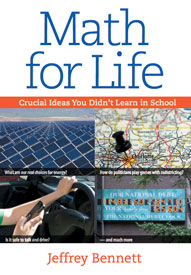 One often hears people state “I’m not good at math” or that they don’t like math because it they don’t think it has any relevance to their day-to-day life (other than, maybe, to balance a checkbook). However, both of those myths are addressed head-on in a new book titled “Math for Life: Crucial Ideas You Didn’t Learn in School.” The author of that book is Dr. Jeffrey Bennett, an astrophysicist and educator. He has written several text books and books for the general public including the popular series of children’s books (“Max goes to the Moon” and other places around the solar system) and now another new children’s book called “The Wizard Who Saved the World.” We are happy to have Jeff back on our show in this episode to talk about the importance of math to how we make decisions in our personal lives, in our community, and in Congress…and about being a Wizard.
Hosts: Joel Parker, Breanna Draxler
Headlines: Breanna Draxler, Beth Bartel
Engineer: Joel Parker
Producer: Joel Parker
Executive Producer: Tom McKinnon
Podcast: Play in new window | Download (Duration: 24:14 — 22.2MB)
Subscribe: RSS
(credit: NASA, ESA, M. Showalter, Z. Levay)”]![Pluto and its moons [click to enlarge] (credit: NASA, ESA, M. Showalter, Z. Levay)](http://howonearthradio.org/wp-content/uploads/2011/08/hs-2011-23-d-web_print.jpg "hs-2011-23-d-web_print") Feature #1:
Feature #1:
Last month, astronomers working on the Hubble Space Telescope announced the discovery of another, fourth moon around Pluto; this moon is so small that it could fit easily inside Boulder County (a pretty tricky thing to find at a distance of three and a half billion miles). The researchers who found the new moon were making observations in support of NASA’s New Horizons spacecraft, which is en route to fly by and study Pluto in 2015, and continue onward to explore the mysterious region beyond Pluto’s orbit known as the Kuiper Belt. How On Earth’s Ted Burnham recently met with Alan Stern, principal investigator on New Horizons, to talk about what the discovery means for that mission. [An extended version of the interview also is available.]
Feature #2:
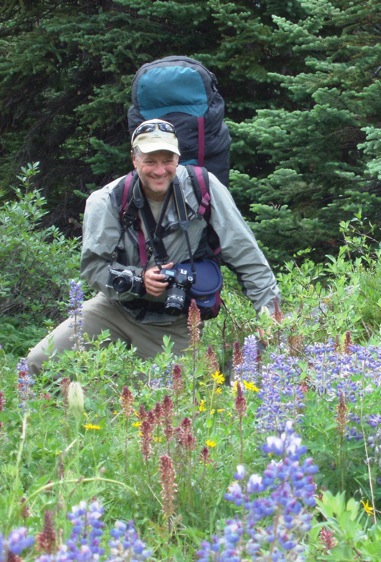
The significant loss of species on Earth is primarily due to human destruction of habitats, forests and other wild nature, to make room for new development and agriculture. Climate change is also accelerating the rate of species extinction. Among the efforts worldwide to protect wilderness and nature so wild animals can survive is a Boulder-based nonprofit called The WILD Foundation. Harvey Locke is the organization’s vice president for conservation strategy and he helped launch the Yellowstone to Yukon Conservation Initiative (Y2Y) several years ago and oversees a global campaign called Nature Needs Half. Y2Y’s goal is to create a continuous 2,000-mile corridor for wildlife from Yellowstone National Park in the U.S. to the Yukon in Northern Canada. Harvey joins us in the studio to talk about that campaign and the science behind wildlife preservation targets.
Co-hosts: Susan Moran and Joel Parker
Engineer: Joel Parker
Executive Producer: Susan Moran
Show Producer: Joel Parker
Podcast: Play in new window | Download (Duration: 24:36 — 22.5MB)
Subscribe: RSS
On today’s show we featured an interview with Alan Stern of the Southwest Research Institute, who is principal investigator on NASA’s New Horizons mission. He told us about a fourth, tiny moon orbiting Pluto—found last month by his team during observations in support of New Horizons, which will arrive at Pluto in 2015. Here’s an extended version of that interview.
Podcast: Play in new window | Download (Duration: 10:16 — 9.4MB)
Subscribe: RSS
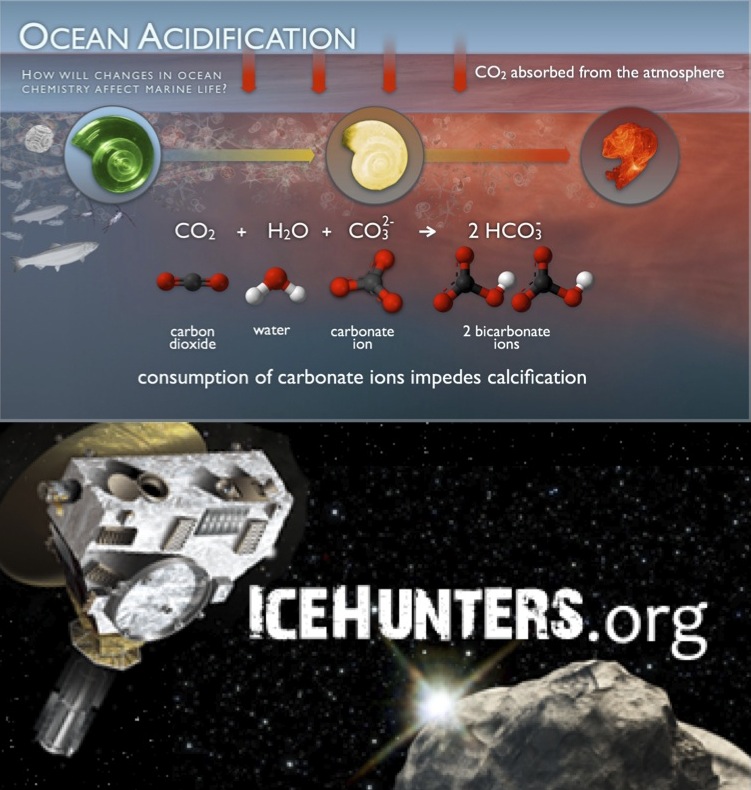
Feature #1: Many problems plague the oceans and the fish and other species that inhabit them: overfishing, pollution, and much more. But perhaps the greatest threat to sea life – and possibly to humans – is ocean acidification. That’s when the chemistry of the ocean changes and causes seawater to become more acidic because the ocean is absorbing carbon dioxide from the atmosphere. This increase in ocean acidity makes it difficult for many plants and animals in the ocean to make or maintain their shells or skeletons. The head of the National Oceanic and Atmospheric Administration (NOAA), Jane Lubchenco, recently said that the ocean is becoming more acidic at rates not seen for at least 20 million years, and that’s due mostly to increases in CO2 in the atmosphere. The threat is so grave that NOAA recently created a distinct Ocean Acidification Program. In May, Dr. Libby Jewett was appointed the first director of the program. We talk with Dr. Jewett find out more about the problem and what she aims to do about it.
Feature #2: Some sciences have a tradition of fruitful interactions between professional researchers and amateurs, and this has been made even more accessible with data being able to be shared over the internet across the world. Dr. Pamela Gay, an Astronomer at Southern Illinois University, Edwardsville, is the architect and participant in many such collaborations. In addition to her teaching and research, she does extensive public outreach to share the excitement of astronomy (such as her podcast AstronomyCast.com) and even finds ways to let anyone with an internet connection make new scientific discoveries and find new worlds that will be visited by spacecraft (IceHunters.org). We talk with Dr. Gay about the Zooniverse and her hunt for of icy objects in the outer solar system.
Hosts: Susan Moran and Joel Parker
Producer: Joel Parker
Engineer: Tom McKinnon
Listen to the show:
Podcast: Play in new window | Download (Duration: 24:39 — 29.4MB)
Subscribe: RSS

This week on How On Earth, University of Colorado earth scientist Roger Bilham joins us in the studio to talk about his latest study, which shows a correlation between the prevalence of corruption in a country and the likelihood of civilian deaths during an earthquake. And Shelley Schlender talks to HOE contributor and astrophysicist Joel Parker about how the science of astronomy can have an impact on the pseudoscientific world of astrology.
Hosts: Tom Yulsman, Ted Burnham
Producer: Tom Yulsman
Listen to the show:
Podcast: Play in new window | Download (Duration: 23:00 — 21.1MB)
Subscribe: RSS
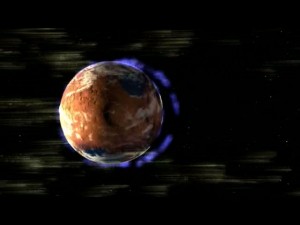
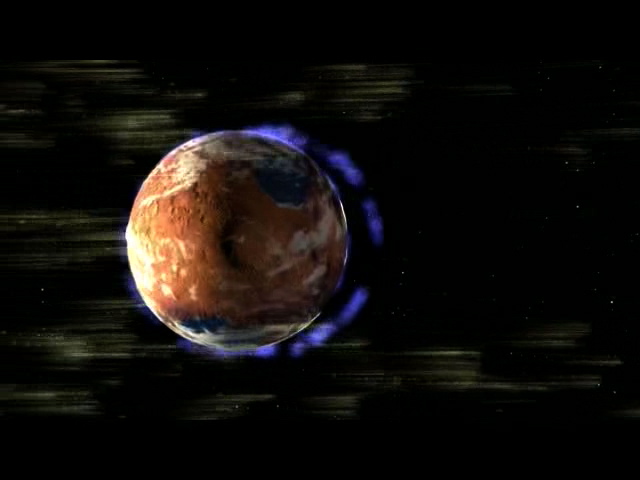
On this week’s How On Earth, we’re joined by the University of Colorado’s Bruce Jakosky, principle investigator on the MAVEN satellite mission that will investigate Mars’ upper atmosphere. NASA granted final approval to MAVEN last fall, and the spacecraft is scheduled to launch in 2013. Also, Ted Burnham speaks with Carol Finn, incoming president of the American Geophysical Union, about the need for scientists to communicate better with the public.
Hosts: Joel Parker, Ted Burnham
Producer: Shelley Schlender
Listen to the show:
Podcast: Play in new window | Download (Duration: 25:42 — 35.3MB)
Subscribe: RSS