Welcome to a special Radio Nibbles version of How On Earth. Nibbles’ (and pie aficionado) John Lehndorff, chef Ian Kleinman and How On Earth’s Jim Pullen set to work making and eating high-tech delicacies. Liquid nitrogen sorbets, strawberries floating above superconducting magnets, and more! Food and tech on the show that makes you smarter. Yum!
Host/Producer/Engineer: Jim Pullen Executive Producer: Jim Pullen
Amazon CO2 (start time 04:37)The Amazon basin contains the largest tropical rainforest on the planet. It’s been critical not only for its beauty and biodiversity but also for its ability to store more carbon dioxide than it emits. The soil and above-ground biomass of the Amazon makes it one of the largest reservoirs of carbon dioxide. And that has helped to keep climate change from accelerating even faster. But a new study shows that the Amazon’s tropical ecosystems may actually give off more CO2 into the atmosphere than they absorb. To learn what’s shifting in the Amazon basin and the implications of this shift, host Susan Moran speaks with one of the authors of the study. John Miller is a scientist with the National Oceanic and Atmospheric Administration in Boulder. Specifically, he’s with NOAA’s Cooperative Institute for Research in Environmental Sciences, which is at the University of Colorado.
Power Plant Smokestacks (start time 14:43) To understand the global greenhouse gas budgets, it’s critical to characterize their sources and sinks. Electrical power generation accounts for about a third of all greenhouse gas emissions in the US. While the actual generation of power is only part of the entire production and use cycle of electricity, power generation stations are an important part of the budget. A definitive study of smokestack gases shows that power plant emissions in the US are down and that combined-cycle gas powered plants have much lower emissions than the coal plants they are replacing. How On Earth host Jim Pullen talks with the study’s lead author, Dr. Joost de Gouw. Joost is also with the Cooperative Institute for Research in Environmental Sciences at the University of Colorado in Boulder and also NOAA’s Earth System Research Laboratory (ESRL), Chemical Science Division.
Hosts: Jim Pullen, Susan Moran Producer: Jim Pullen Engineer: Jim Pullen Executive Producer: Jim Pullen Additional contributions: Joel Parker and Kendra Krueger
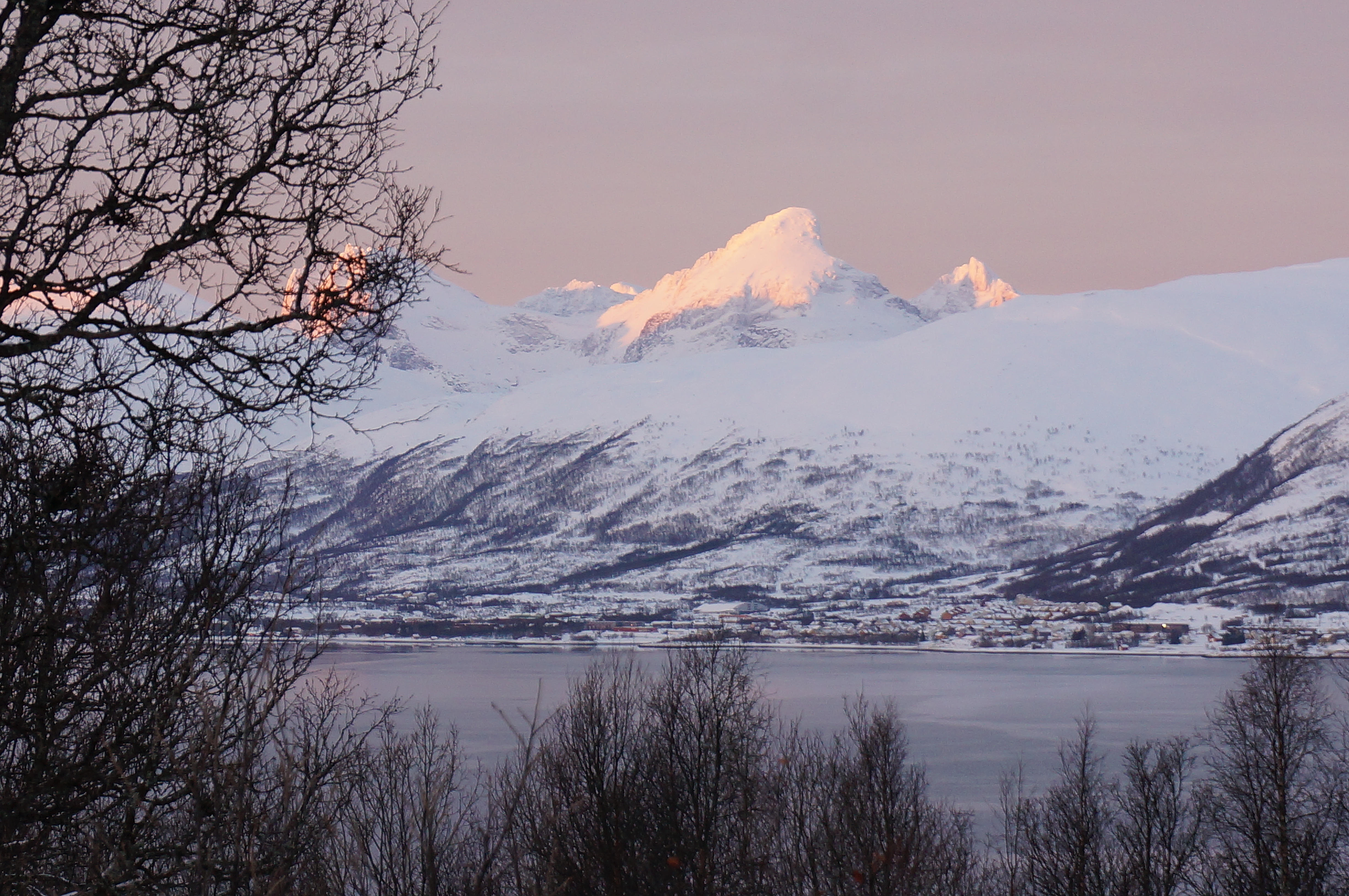
Arctic sunset over Tromso, Norway, Photo courtesy Susan Moran
Arctic Dispatch: (start time: 1:02) Co-host Susan Moran returns from Tromso, Norway, with a dispatch from the Arctic Frontiers conference, which addressed the human health and environmental impacts of a rapidly thawing Arctic. Lars Otto Reierson, executive secretary of the Arctic Monitoring and Assessment Program within the Arctic Council, discusses the transport and impacts of contaminants on the Arctic food web and the indigenous people who depend on it. And Michael Tipton, a physiologist at the University of Portsmouth in the U.K., speaks about the risks of and physiological responses to extreme cold environments. Read Susan’s article in Popular Science for more about the thawing Arctic.
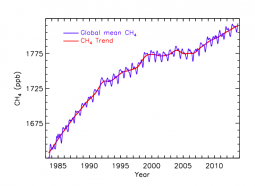
Source: Ed Dlugokencky, NOAA
Atmospheric methane spikes: (start time: 9:39) Dr. Ed Dlugokencky, an atmospheric chemist with NOAA’s Earth Systems Research Laboratory, speaks with co-host Jim Pullen about a paper he co-authored in Science about a recent spike in atmospheric concentrations of methane, which is 30 times more effective than carbon dioxide as a greenhouse gas. The graph to the right shows globally averaged methane (blue) and its de-seasonalized trend (red) determined from NOAA’s global cooperative air sampling network. To learn more about KGNU’s coverage of fracking issues, visit our fracking blog!
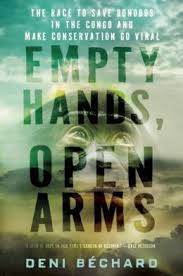
Bonobo Conservation Success: (start time: 16:11) Author Deni Bechard speaks with Susan Moran about his new book, Empty Hands, Open Arms: The Race to Save Bonobos in the Congo and Make Conservation Go Viral. The book highlights the success that a nonprofit is having in the Democratic Republic of the Congo in sparing the animals from extinction while economically benefiting local communities.
Hosts: Susan Moran, Jim Pullen Producer: Susan Moran Engineer: Jim Pullen Executive Producer: Jim Pullen
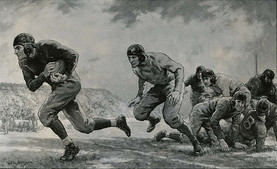
The science of football. (image courtesy of the Connecticut State Library)
Newton’s Football (start time 5:45) This Sunday the Denver Broncos face the Seattle Seahawks in the Super Bowl, so we thought we’d bring you a scientific perspective on the game of football. How on Earth’s Ted Burnham talks with the co-authors of the book Newton’s Football: The Science Behind America’s Game, journalist Allen St. John and science evangelist Ainissa Ramirez.
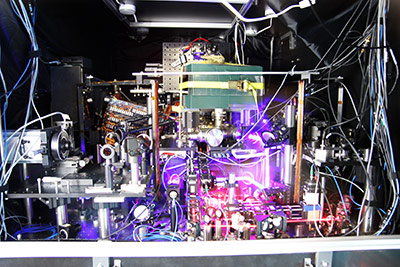
Strontium Clock (start time 14:10) We’ve got a full-house of physicists in the studio today to help us understand the new timepiece and why it’s important. Travis Nicholson and Sara Campbell are graduate students on the team led by Professor Jun Ye. Dr. Ye is a Fellow of JILA, a Fellow of NIST, and Adjoint Professor with CU’s Department of Physics.
Hosts: Ted Burnham, Jim Pullen Producer: Joel Parker Engineer: Joel Parker Executive Producer: Jim Pullen Additional contributions: Kendra Krueger, Beth Bartel, Joel Parker, Jim Pullen
Outsourcing Pollution (01:08) What’s sent to China comes back to the good old U S of A.
Arctic Frontiers (02:03) How on Earth’s Susan Moran flies to Norway Conference
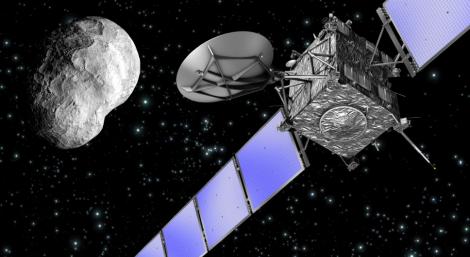
Wake Up, Rosetta! (3:00) As project manager for the Rosetta Alice UV Spectrometer, How on Earth’s Joel Parker shares tense moments, waiting for Rosetta to wake up.
Jelly Sandwich Earth (5:40) CU-Boulder’s Peter Molnar wins the world’s most prestigious prize for Geoscience -He speaks with How on Earth’s Jim Pullen
Hospital Acquired Infections (8:00) When Americans go to the hospital, they don’t expect to leave with a brand new illness. But one out of every 20 receives a hidden time bomb during these visits — it’s a healthcare associated infection. How on Earth’s Shelley Schlender visits Longmont United Hospital to see how ICU staff reduce infection risks. If you want to compare how your hospital or clinic compares with the nation, and other Colorado hospitals, when it comes to infections, here are Colorado’s Latest Infection Rate Reports
Gut Microbe Reverses Autism in Mice (15:22) A recent study and a commentary in Cell indicate that feeding mice a beneficial bacteria reduces their autistic symptoms. CU Biofrontiers Institute scientists Dorota Porazinska and Sophie Weiss discuss the implications with Shelley Schlender.
Hosts: Shelley Schlender, Jim Pullen Producer: Shelley Schlender Engineer: Shelley Schlender Executive Producer: Jim Pullen Additional contributions: Ted Burnham, Kendra Krueger, Susan Moran, Jane Palmer, Joel Parker
Quitting smoking (start time 4:39) 50 years ago, the U.S. Surgeon General began a campaign against cigarettes that has saved million of lives. Cohost Jim Pullen talks with Dr. Amy Lukowski about proven strategies to stop smoking and a special quitting campaign for women who are pregnant. Dr. Lukowski is the Clinical Director of the Health Initiatives Programs for National Jewish Health.
If you’d like to learn more about kicking the habit, visit the Colorado Quitline.
(photo courtesy K.West / California National Primate Research Center)
Smoke and children’s health (start time 13:36) It’s been known for some time that breathing in smoke from wildfires — or wood stoves, for that matter — is bad for your health.
Many studies have shown that when children are exposed to inhalable particulate matter early in life, their lungs don’t function properly. And the effect on the lungs from inhaling smoke persists as children grow older.
But what has not been well understood is precisely what is happening in a person’s body that causes the harmful effects — the biologic mechanism. Also, there is no data available on the long-term impact of exposure to air pollutants on the immune systems of human infants and school children.
A new study helps to narrow the gaps in our understanding of the effects of air pollutant exposure early in life. And in fact, the study was conducted on monkeys, not humans.
Cohost Susan Moran’s guest is Dr. Lisa Miller, who led the new study. She’s an associate professor in the School of Veterinary Medicine at the University of California at Davis. And she is Associate Director of Research at the California National Primate Research Center at the university.
Hosts: Jim Pullen, Susan Moran Producer: Jim Pullen Engineer: Jim Pullen Executive Producer: Jim Pullen Additional contributions: Beth Bartel, Ted Burnham, Kendra Krueger, Shelley Schlender
For our first show in 2014 we offer two feature interviews:
Feature #1: We continue our conversation from Dec. 31 with science writer and CU professor Tom Yulsman about what “hot” stories 2014 holds in store regarding earth and planetary science, especially climate and weather. Yulsman, who also writes a regular blog for Discover magazine, called Imageo, talks with co-host Susan Moran.
Feature #2: In expectation of the first official cargo flight of the Cygnus spacecraft to the International Space Station, co-host Joel Parker interviews researchers David Klaus and Stefanie Countryman about their respective experiments: a biomedical antibiotic experiment and an educational K-12 experiment involving ant behavior in microgravity. The Cygnus spacecraft is built by Orbital Sciences Corporation, and follows the earlier, successful launch of a Cygnus demo flight on October 22. The experiments are built by the BioServe Space Technologies Center within the Aerospace Engineering and Sciences Department at the University of Colorado, Boulder.
Hosts: Susan Moran, Joel Parker Producer: Susan Moran Engineer: Joel Parker Executive Producer: Jim Pullen
Due to a technical problem at the station, unfortunately, we were not able to save the audio archive of the show. Our apologies. All other shows include the audio file.
The team considers noteworthy science on the last day of 2013. What’s worth mentioning? Too many people, too much carbon, and way too much fun in astronomy!
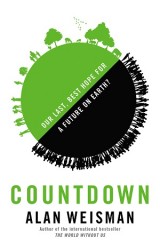
Biology and Health (start time 00:56). This year marked the passing of long-time Boulder resident, Al Bartlett. Bartlett was one of the world’s most eloquent voices calling for population control. He will be missed. One of the champions picking up the torch is New York Times bestselling author, Alan Weisman. Weisman offers exciting solutions to population growth in Countdown: Our Last, Best Hope for a Future on Earth.
How on Earth’s Shelley Schlender reports that this is a hard book to read, because it’s long, and thorough, and urgency of the need for population reduction worldwide is often not a happy topic. She admits that sometimes, she even switched to a detective novel before reading more of Countdown. But she kept at it because Countdown provides some exciting solutions to population growth. One of the most compelling is to provide women with education and access to birth control. It turns out these two offerings are often a key to women deciding, voluntarily, to limit their families to two children, and sometimes, fewer.
Co-host Shelley Schlender hosts this interview with Weisman about perhaps the greatest problem facing humanity–too many people.
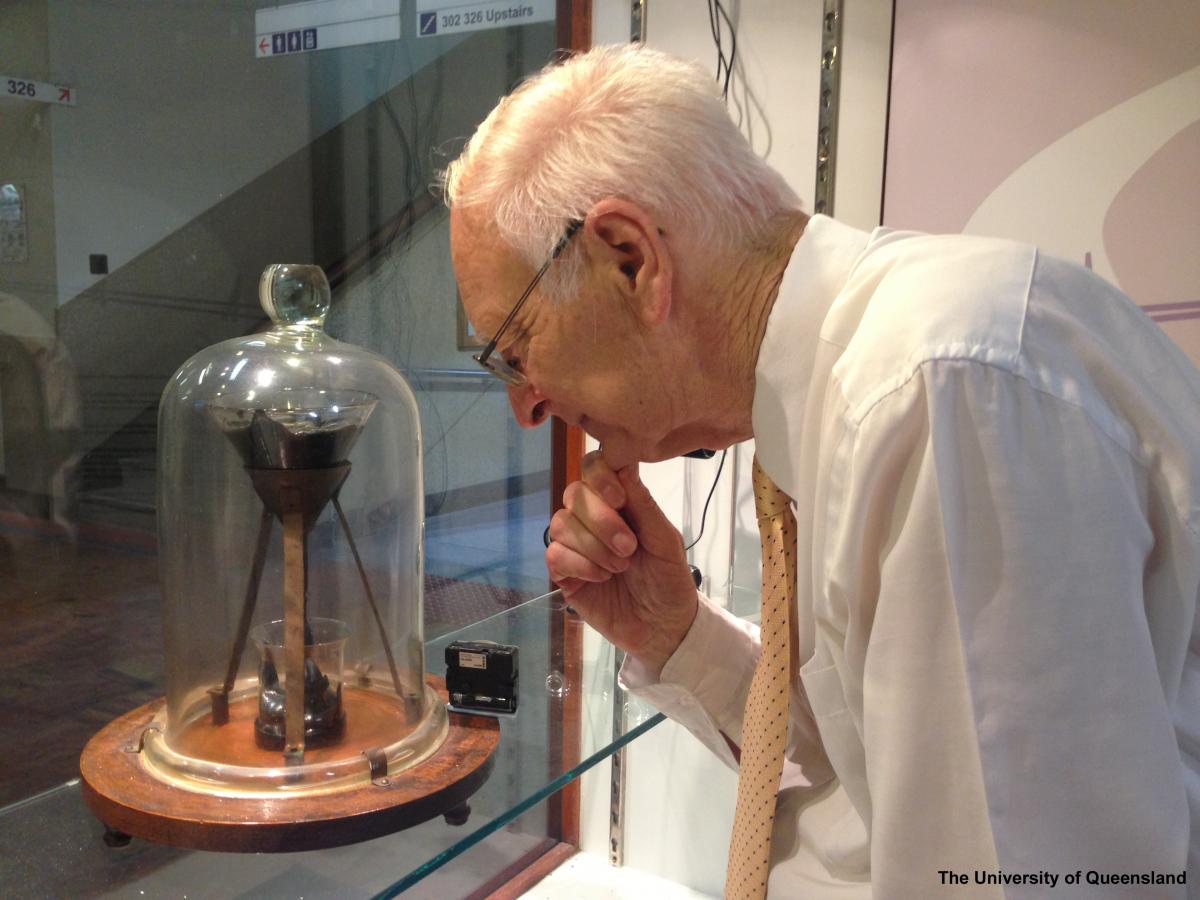
The late Professor John Mainstone cared for the pitch drop experiment. (University of Queensland, Australia)
Physics and Astronomy (start time 08:56). Co-host Jim Pullen couldn’t decide on the best physics and astronomy story of 2013, so he dipped into the rich happenings of the year, taken from all over the world: superbolides skipping over Russia, bitumen dripping in Ireland, Voyager 1 long-ranging somewhere in the galaxy, and Icecube spying far-flung neutrinos down at the bottom of the world (and beyond). We’ll learn that the news of 2013 owes much to 2012, 1977, 1944 and even 1927. And that leaves WIMPS, dark matter, LUX, two-dimensional graphene, trapped quantum states, quantum computers, and so much more for 2014!
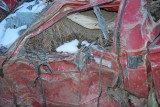
Flood crumpled truck in Jamestown Canyon, Colorado (photo courtesy Jim Pullen)
Environment (start time 16:44). What a year it’s been! We shot past 400 ppm of CO2 in the ever-warming blanket of air skinned over the planet. And disasters! Mighty and perilous Super Typhoon Haiyan, with the fastest winds ever recorded, crashed into the Philipines in November. More locally, in September here on the Northern Front Range, a flood of historic proportion. Co-hosts Susan Moran and Tom Yulsman look at the perils of 2013 and portents.
Happy 2014 to you, our KGNU and How On Earth family!
Hosts: Shelley Schlender, Jim Pullen, Susan Moran Producer: Jim Pullen Engineer: Jim Pullen Executive Producer: Beth Bartel
We offer two features on this Christmas Eve How On Earth.
Fairies in 19th century science education (start time: 3:52): Victorian educators used the magical world to teach young children about science. That was before fairies fell out of favor in science, alas. How On Earth co-host Jim Pullen talks with Melanie Keene, director of Studies for History and Philosophy of Science at Homerton College in Cambridge, England, about the understanding of fairies in science education in the Victorian age.
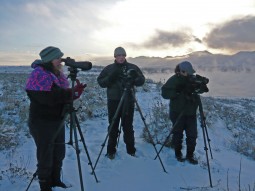
Christmas Bird Count (start time: 12:51) It’s the time of year when humans are flying hither and yon to gather with family for Christmas. Others are heading somewhere south for vacation to escape the winter chill. Many birds are on the move as well, heading south to overwinter. Others are sticking around. These human and avian patterns are converging with the annual Audubon Society’s Christmas Bird Count. Steve Jones and William Schmoker of the Boulder County Audubon Society talk with co-host Susan Moran about how the Bird Count emerged more than 100 years ago and why it’s important.
Hosts: Susan Moran, Jim Pullen Producer: Susan Moran Engineer: Jim Pullen Executive Producer: Beth Bartel
Listen to the show:
Fireproofing Mountain Homes (starts at 3:20) We discuss a new study from the Rocky Mountain Research Station in Missoula, Montana. It warns that thinning forests may help prevent property damage from the “typical” wildfires, fire suppression can’t stand up against the 3% of fires that burn super-hot and spread super fast. What’s more, the Missoula study warns that superhot wildfires are just the ones that burn the most homes. The researchers conclude that the main responsibility for preventing home destruction from wildfires, lies with homeowners rather than public land managers. They say that homeowners should do more to design homes that stand up to a super wildfire. To find out ways to to that, we talk with Disaster Safety Senior Scientist Steve Quarles, who is with an insurance industry funded fire prevention think tank. Quarles says that small changes in home building can reduce the chance that tiny, glowing embers blowing in the wind, will get in under the eaves and turn into a raging fire that burns down a house.
Winter Solstice (starts at 13:44) As a chart of sunrise and sunset makes clear, although the shortest day of the year is at the winter solstice, the latest sunrise occurs *after* the solstice and the earliest sunset occurs *before* the solstice… The sunset is going to get later faster and faster now, while the sunset time is going to also get later until after the solstice, then start creeping earlier. What’s going on here? How on Earth’s Jim Pullen explains.
Hosts: Shelley Schlender, Jim Pullen Producer: Shelley Schlender Engineer: Jim Pullen Executive Producer: Beth Bartel

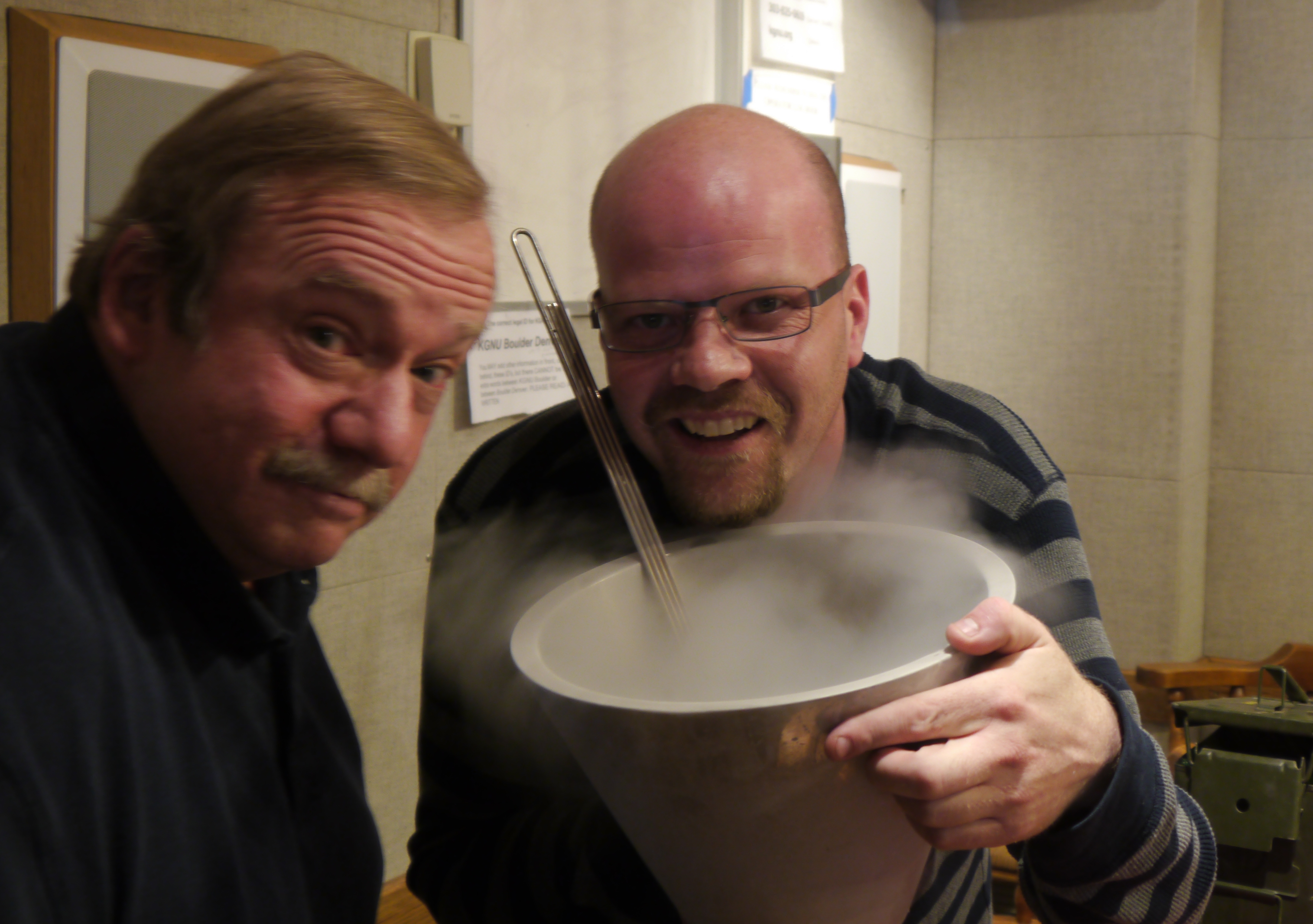
 Welcome to a special Radio Nibbles version of How On Earth. Nibbles’ (and pie aficionado) John Lehndorff, chef Ian Kleinman and How On Earth’s Jim Pullen set to work making and eating high-tech delicacies. Liquid nitrogen sorbets, strawberries floating above superconducting magnets, and more! Food and tech on the show that makes you smarter. Yum!

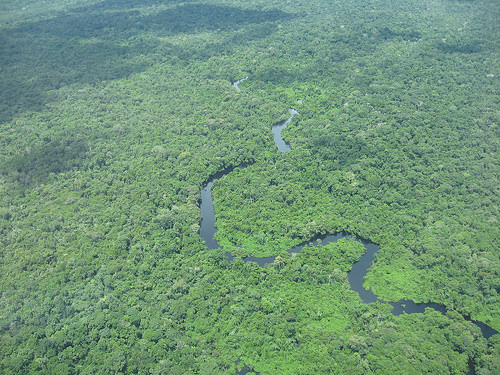
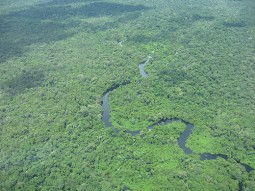 Amazon CO2 (start time 04:37) The Amazon basin contains the largest tropical rainforest on the planet. It’s been critical not only for its beauty and biodiversity but also for its ability to store more carbon dioxide than it emits. The soil and above-ground biomass of the Amazon makes it one of the largest reservoirs of carbon dioxide. And that has helped to keep climate change from accelerating even faster. But a new
 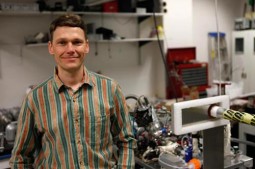 Power Plant Smokestacks (start time 14:43) To understand the global greenhouse gas budgets, it’s critical to characterize their sources and sinks. Electrical power generation accounts for about a
 Bonobo Conservation Success: (start time: 16:11) Author
 Strontium Clock (start time 14:10) We’ve got a full-house of physicists in the studio today to help us understand the new





 Quitting smoking (start time 4:39) 50 years ago, the U.S. Surgeon General began a


 For our first show in 2014 we offer two feature interviews:
 Feature #2: In expectation of the first official cargo flight of the
 Biology and Health (start time 00:56). This year marked the passing of long-time Boulder resident, Al Bartlett. Bartlett was one of the world’s most eloquent voices calling for population control. He will be missed. One of the champions picking up the torch is New York Times bestselling author, Alan Weisman. Weisman offers exciting solutions to population growth in Countdown: Our Last, Best Hope for a Future on Earth.



 Christmas Bird Count (start time: 12:51) It’s the time of year when humans are flying hither and yon to gather with family for Christmas. Others are heading somewhere south for vacation to escape the winter chill. Many birds are on the move as well, heading south to overwinter. Others are sticking around. These human and avian patterns are converging with the annual Audubon Society’s